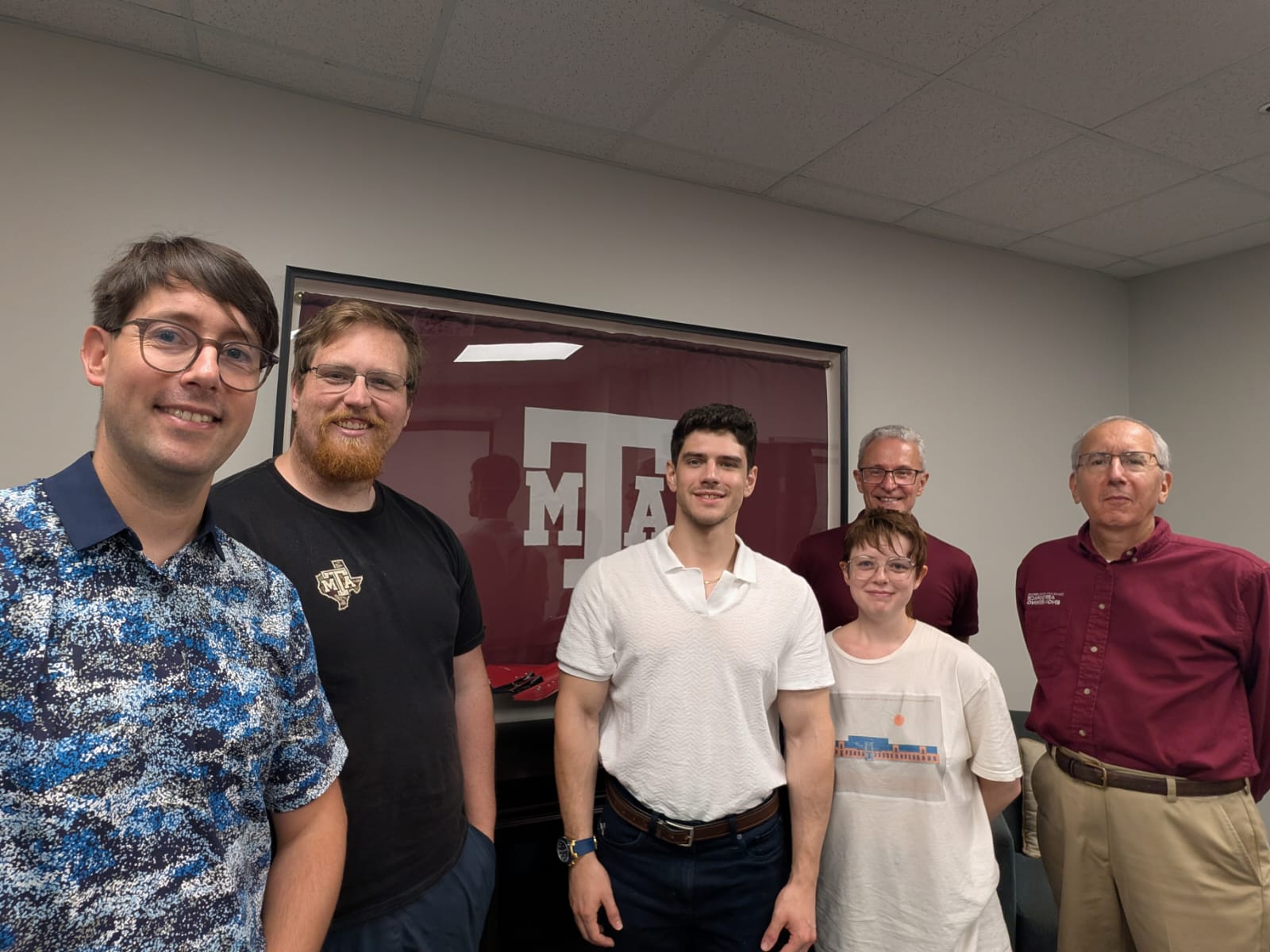
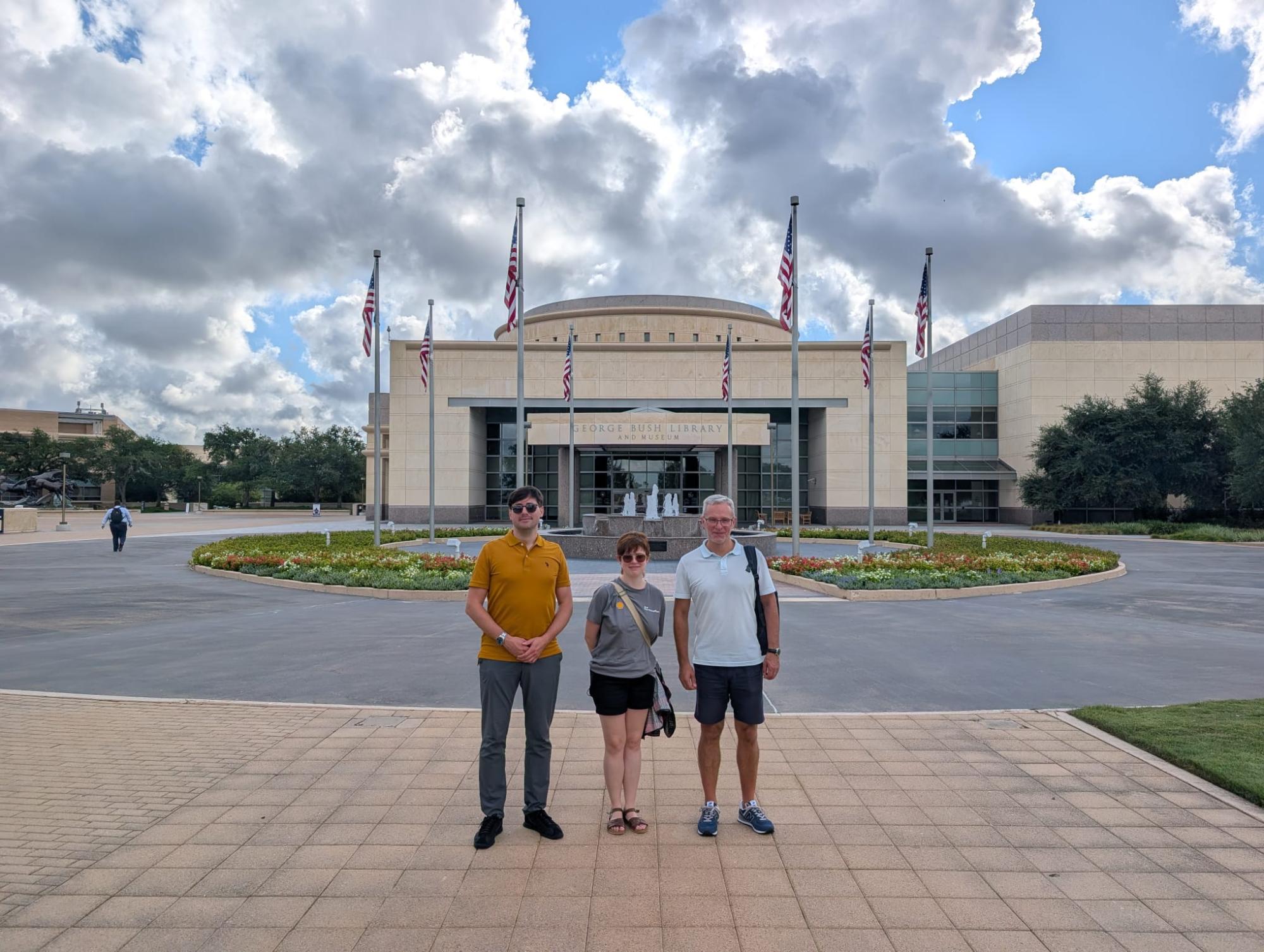
The team of the Institute of Turbomachinery at Texas A&M University.

Between 5 and 20 September 2026, Prof. Grzegorz Liśkiewicz, Prof. Artur Gutkowski and PhD candidate MSc Eng. Aleksandra Woźniak visited Texas A&M University in College Station (Texas, USA), where they were hosted by Prof. Paul Cizmas and his team at the Department of Aerospace Engineering. The visit took place within the framework of the international project ‘H2mJet: A Hydrogen Combustor for Jet Engines’, carried out jointly by Texas A&M University, Lodz University of Technology (Institute of Fluid‑Flow Machinery), and the A.M. Pidhorni Institute of Mechanical Engineering and Energy Systems of the National Academy of Sciences of Ukraine.
The aim of the project is to redesign the combustion chamber of the Microturbo TRS‑18 small turbojet engine so that it can operate on pure hydrogen or on a mixture containing at least 40% hydrogen and Jet A aviation fuel. The modernised chamber will undergo experimental testing at the Propulsion Laboratory of Texas A&M University, and the performance of the hydrogen‑fuelled engine will be compared with its operation on conventional fuel. The project contributes to global efforts toward the decarbonisation of aviation. To date, most research on hydrogen combustion has focused on power‑generation turbine combustors. In contrast, H2mJet addresses an annular combustion chamber used in modern aircraft engines, analysed under pressure conditions characteristic of real jet engines.
During their stay, the researchers worked on improving numerical models of the engine’s compressor and combustion chamber. The team from Lodz University of Technology contributes expertise in compressor design and flow‑stability analysis, which is particularly important in the context of potential pressure oscillations in the combustion chamber. The delegation was warmly received by Prof. Paul Cizmas and his group, for which we express our gratitude. The visit also provided an opportunity to explore the research facilities and laboratories of one of the leading technical universities in the United States.
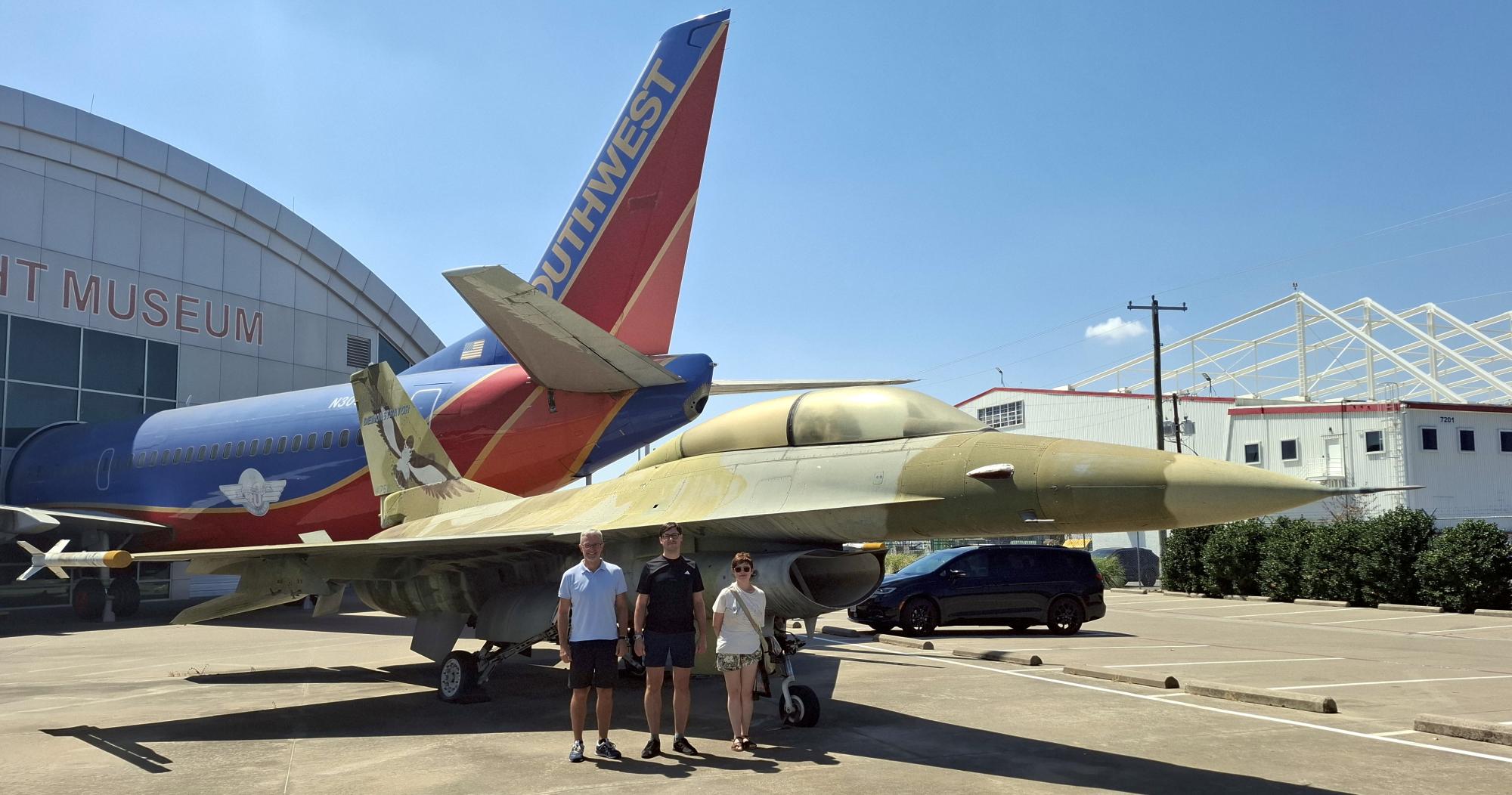
In their free time, the participants visited Space Center Houston, the visitor centre of NASA’s Johnson Space Center. The Saturn V rocket — one of only three remaining examples — made a particularly strong impression, as did the replica of the Independence space shuttle mounted atop a Boeing 747 used for shuttle transport. Another highlight of the trip was the Frontiers of Flight Museum in Dallas, showcasing the history of aviation and space exploration. Among its exhibits is the command module from the Apollo 7 mission, the first crewed mission of the Apollo programme.
For a team working daily with fluid‑flow machinery and aircraft propulsion systems, both visits offered an inspiring complement to the scientific stay and an opportunity to reflect on the history of the technologies that the H2mJet project seeks to help advance.